

Few cheeses are as recognisable in the hand as halloumi. It is firm rather than soft, it holds a slice cleanly, and it behaves in a hot pan in a way that surprises anyone meeting it for the first time. That behaviour is not a trick of processing. It follows directly from a method that Cypriot cheesemakers settled on generations ago and that has changed remarkably little since.
What follows is a producer's account: what halloumi is, why it belongs to Cyprus, how it is made, why it survives the grill, and what the term PDO actually means when it appears on a label. Where a detail is specific to our own dairy, we say so. Where it is general to the cheese, we describe it as such.
What is halloumi?
Halloumi is a semi-hard brined cheese, pale ivory in colour, sold in slabs or blocks and traditionally folded once so that the finished piece carries a visible seam. It is made from milk that is coagulated in the usual way, but the curd is then heated — cooked, in effect — before the cheese is shaped and placed in brine. Mint is often laid between the folds, a practice as old as the cheese itself.
The texture is the first thing people notice. Halloumi is dense and slightly springy, closer to a firm mozzarella than to a cheddar, but with none of the stretch. Cut it cold and it yields with a clean edge. Bite into it and it resists briefly before giving way. That resistance is the reason for the squeak: the protein structure is tight and elastic enough to drag against tooth enamel, producing a sound that is, for most people, half the pleasure of eating it.
The flavour is mild and clean, carried by salt from the brine rather than by any strong ripening character. Young halloumi tastes of milk. It is not a cheese that announces itself; it is a cheese that takes on whatever it is cooked with — lemon, olive oil, watermelon, honey, herbs, chilli, bread.
Above all, halloumi tolerates heat. Most cheeses collapse and flow when they are warmed past a certain point; halloumi softens, releases a little moisture, browns and keeps its shape. Cypriots eat it fried at breakfast, grilled at lunch and cold with fruit in summer. Elsewhere it has become the cheese people reach for when a dish needs substance without meat. A fuller account of its definition and origins sits on our page explaining what halloumi is and where it comes from.
Halloumi and Cyprus
Halloumi is Cypriot. It is made across the island, eaten at almost every table, and bound up with the rhythms of the year: the milking season, the making, the brining, the keeping. Households once made their own and stored it in earthenware or tins of brine so there would be cheese long after the milk had stopped. That habit of preserving is why the cheese exists in the form it does — heating the curd and holding it in salt were practical answers to a hot climate and no refrigeration.
Because of that, halloumi carries a weight in Cyprus that is difficult to translate. It appears at breakfast with bread and olives, at Easter tables, on the grill at every gathering where a fire is lit. It is given as a gift and carried abroad in suitcases. It is also, plainly, one of the island's most significant food exports, which is why the question of who may call their cheese halloumi has mattered so much here.
PittaS began in Nicosia in 1939. The dairy has stayed in the same family and in the same city for three generations, making the cheese from Cypriot milk. We make no claim to have invented anything; the method predates us by a long way. What we can say is that the family has been at it continuously since before the war, and that the way we work today grew out of that. The full account is on our heritage page, from a single copper vat in 1939, and the principles the family stands behind now are set out in our own words on the about page.
What makes authentic Cypriot halloumi different?
The word authentic is used loosely in food. Applied to halloumi it should mean something quite specific: cheese made in Cyprus, from Cypriot milk, by the traditional method — curd heated, cheese folded, cheese brined — rather than an imitation of the style produced elsewhere for the same shelf.
Three things tend to separate the genuine article from an approximation. The first is the milk. Cypriot halloumi has historically been made with sheep's and goat's milk, alone or alongside cow's milk, and the proportions used shape the finished cheese — its aroma, its colour, the way it behaves in the pan. The second is the fold. Halloumi is folded by hand while the curd is still warm and pliable; the seam that results is not decorative but structural, and it is the mark of a cheese that has been handled rather than moulded. The third is the brine. Halloumi is a preserved cheese, and the salt is not seasoning added at the end but the medium the cheese lives in.
Beyond that, the difference is one of consistency. A halloumi that grills well every time comes from milk of stable quality and a process run the same way each day. That is unglamorous work, and it is most of what a dairy actually does. The formats we supply — retail packs and foodservice blocks — are listed with their specifications on our page of halloumi formats and product specifications.
What is PDO halloumi?
PDO stands for Protected Designation of Origin. It is an EU quality scheme that ties a product name to a defined geographical area and to a registered specification covering how the product must be made. Once a name is registered, it cannot lawfully be used within the EU for goods produced outside that area or outside that specification. Champagne and Parmigiano Reggiano are the familiar examples; halloumi is registered under the same framework.
For a buyer, provenance protection does two useful things. It makes the name mean something concrete rather than evocative, and it creates a documentary trail: producers working to a registered specification are subject to verification against it, and the paperwork exists to be inspected. If provenance matters to your specification or to your customers, that documentation — not the wording on the front of the pack — is what to ask for.
It is also worth being precise about what PDO does not tell you. It is a statement about origin and method, not a grade of quality, and cheeses that fall outside a registered specification are not for that reason inferior. We set out the mechanics of the scheme, and what an importer should actually check, on the page covering halloumi and Protected Designation of Origin. PittaS makes no PDO claim on this page for its own products; where that question affects your purchasing decision, please ask us directly and we will answer in writing.
How is halloumi made?
The traditional sequence is straightforward to describe and demanding to execute consistently. Milk arrives at the dairy and is prepared. A coagulant is added and the milk sets. The set curd is cut, allowed to firm and separated from the whey. So far this is common to a great many cheeses.
The step that makes halloumi halloumi comes next: the drained curd is heated, usually in whey, until it firms and takes on its characteristic resilience. Heating the curd in this way is what fixes the structure that later refuses to flow in a pan. The heated curd is then lifted out, worked, folded — classically with mint laid inside the fold — and salted.
Finally the cheese is placed in brine. Brining seasons the cheese and preserves it, and traditionally allowed halloumi to be kept for months without cooling. Cheese intended for eating young goes out soon after; cheese left in brine continues to firm and to gain salt.
Nothing in the process is wasted: the whey drawn off during making has always been put back to use in Cypriot dairies rather than discarded. A step-by-step account of the method is being prepared on our page on how halloumi is made, from milk to brine.
Why doesn't halloumi melt like other cheeses?
Melting, in a cheese, is the casein protein network losing its grip. In most cheeses the proteins are held together loosely enough that heat lets them slide past one another; the fat liquefies, the structure gives way, and the cheese flows. That is what makes a good cheddar melt on toast and a mozzarella stretch on a pizza.
Halloumi's proteins have already been through that heat. Cooking the curd during production denatures the proteins and locks them into a dense, cross-linked network before the cheese is ever formed. Reheating it later does not undo that; the network has already taken its final shape. The cheese therefore softens at the surface, expels a little moisture and fat, and browns — but it does not spread.
The high salt content and comparatively low acidity of halloumi work in the same direction. Cheeses that melt readily tend to be more acidic, which loosens the mineral bridges holding the protein network together. Halloumi is drained and heated at low acidity, so those bridges stay in place. What you get in the pan is a firm slice with a caramelised crust and a warm, yielding centre. The chemistry is set out in more detail on our page explaining why halloumi does not melt under heat.
How do you cook halloumi?
Halloumi wants direct, decisive heat and very little time. Slice it around a centimetre thick — thinner and it dries, thicker and the centre stays cool — pat the surface dry, and cook it until it is golden. It is done in a couple of minutes a side. Overcooked halloumi turns rubbery as it loses moisture, so the discipline is in taking it off early rather than in any technique.
Grilling gives the cleanest result: a ridged pan or an overhead grill colours the surface fast and keeps the interior soft. Pan frying is the Cypriot everyday method — a dry, hot pan, no added oil, the cheese releasing enough fat of its own. Barbecuing suits thicker slices or skewers; halloumi is one of the very few cheeses that can go straight onto a grate over coals, and it takes smoke well. Baking is the gentlest option, useful when the cheese is sitting on vegetables or in a traybake and you want it warmed through and lightly browned rather than crusted.
Salt is rarely needed. Acid almost always helps: lemon, a splash of vinegar, tomatoes, or fruit. Halloumi is served hot, straight from the heat, and it does not wait well — which is why it tends to be cooked last and eaten standing up. Method by method, with timings, is covered on our guide to cooking halloumi, and the ways it is used across Cypriot and international kitchens are collected under halloumi recipes and serving ideas.
20 Halloumi Recipes to Try
Discover ways to enjoy authentic Cypriot halloumi — from grilled sandwiches and fresh salads to barbecue kebabs, pasta and sweet recipes.
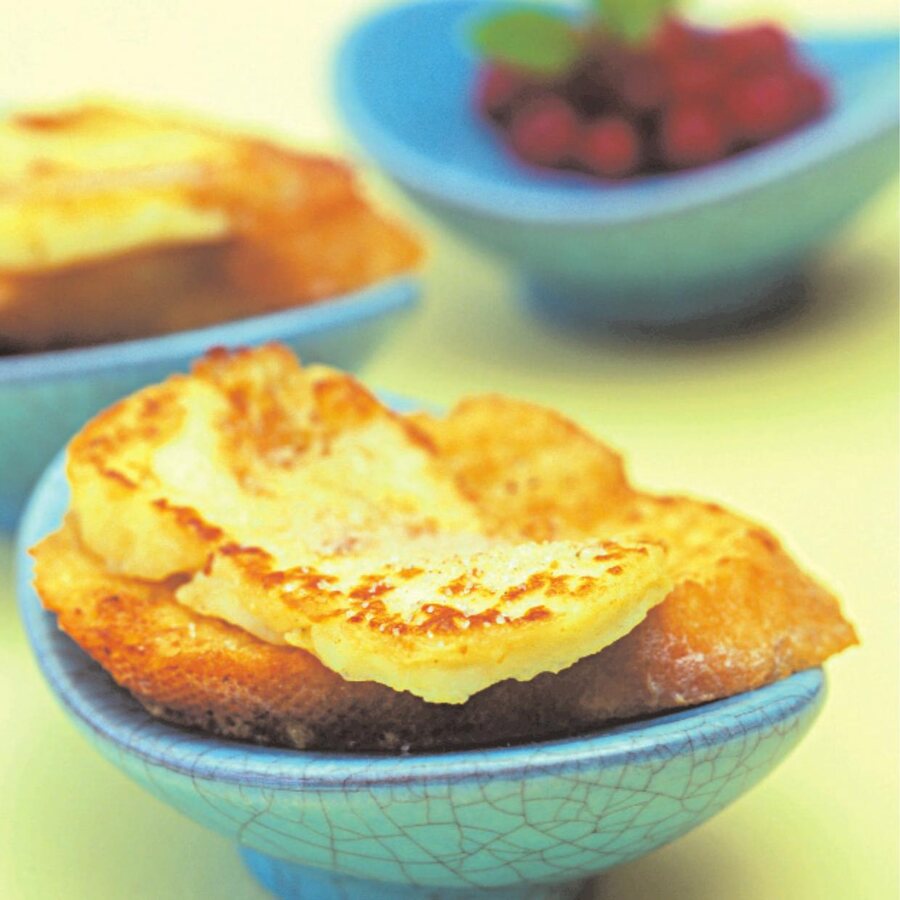
Breakfast & Brunch
Halloumi French Toast
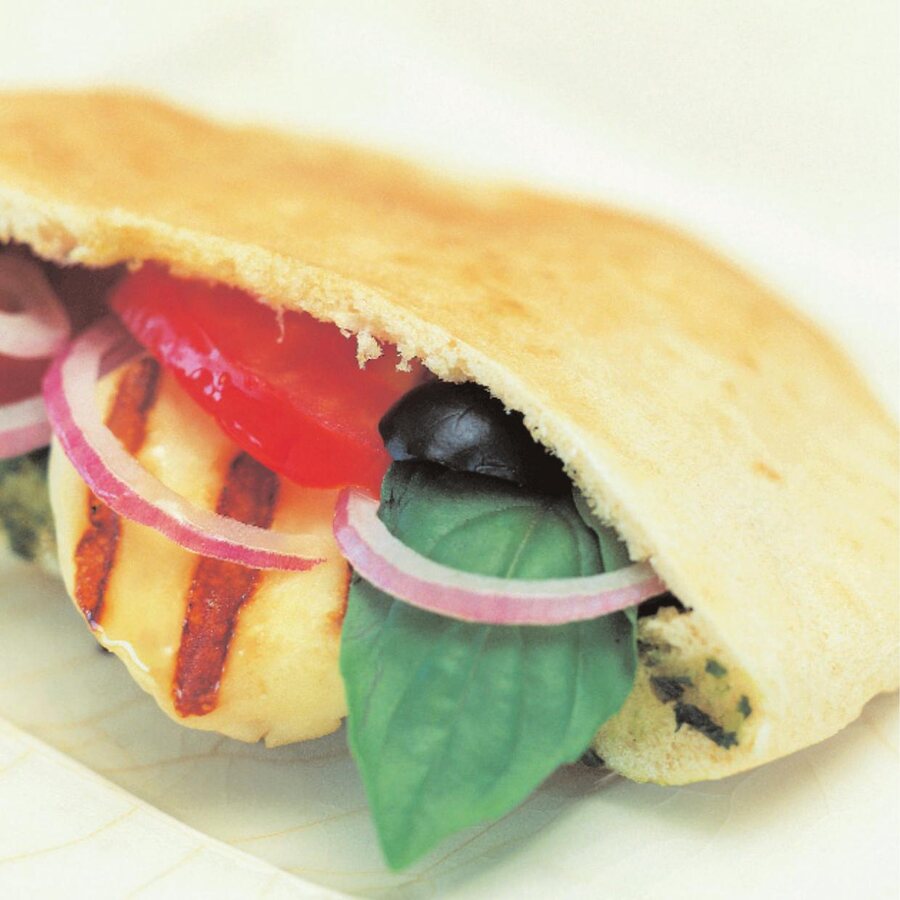
Lunch & Light Meals
Grilled Halloumi Sandwich in Pita Bread
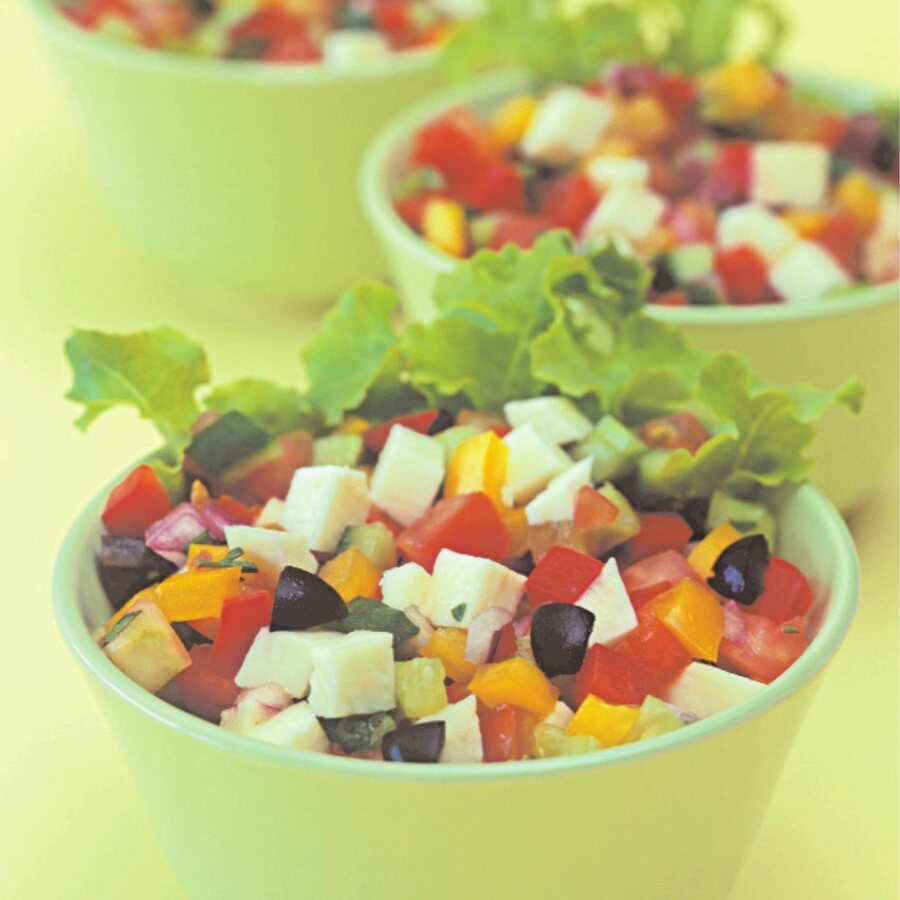
Salads
Halloumi Mixed Vegetable Salad
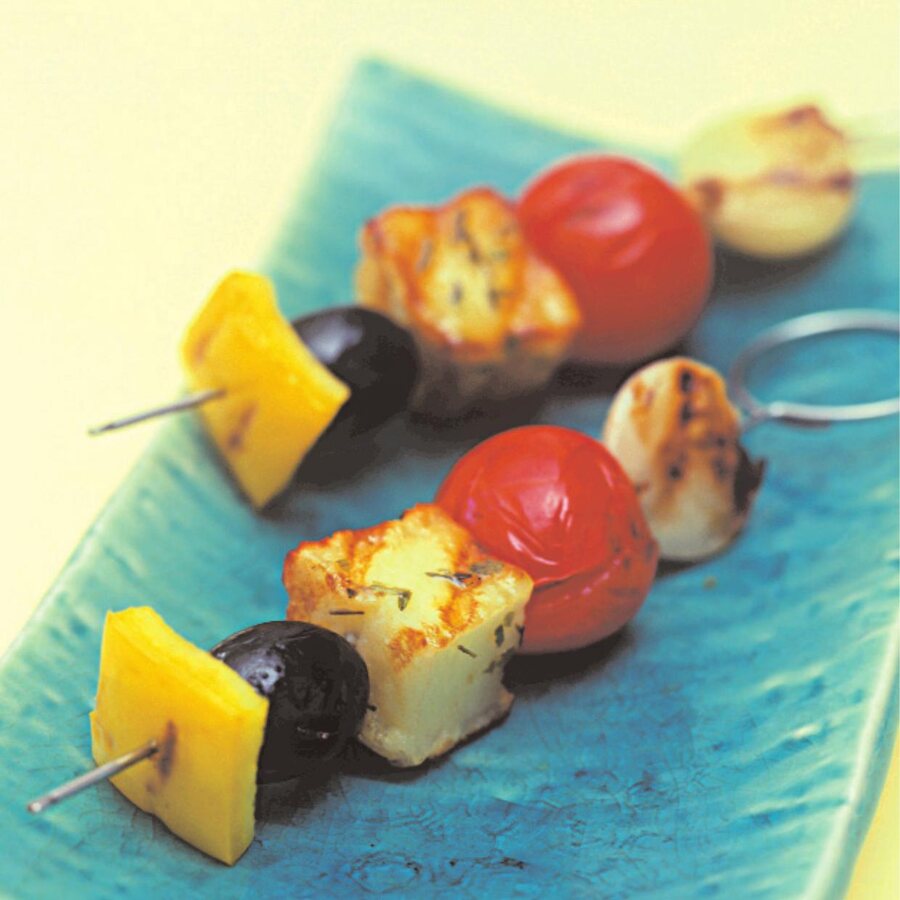
Party & Appetizers
Halloumi Barbecue Kebabs in Fines Herbes Marinade
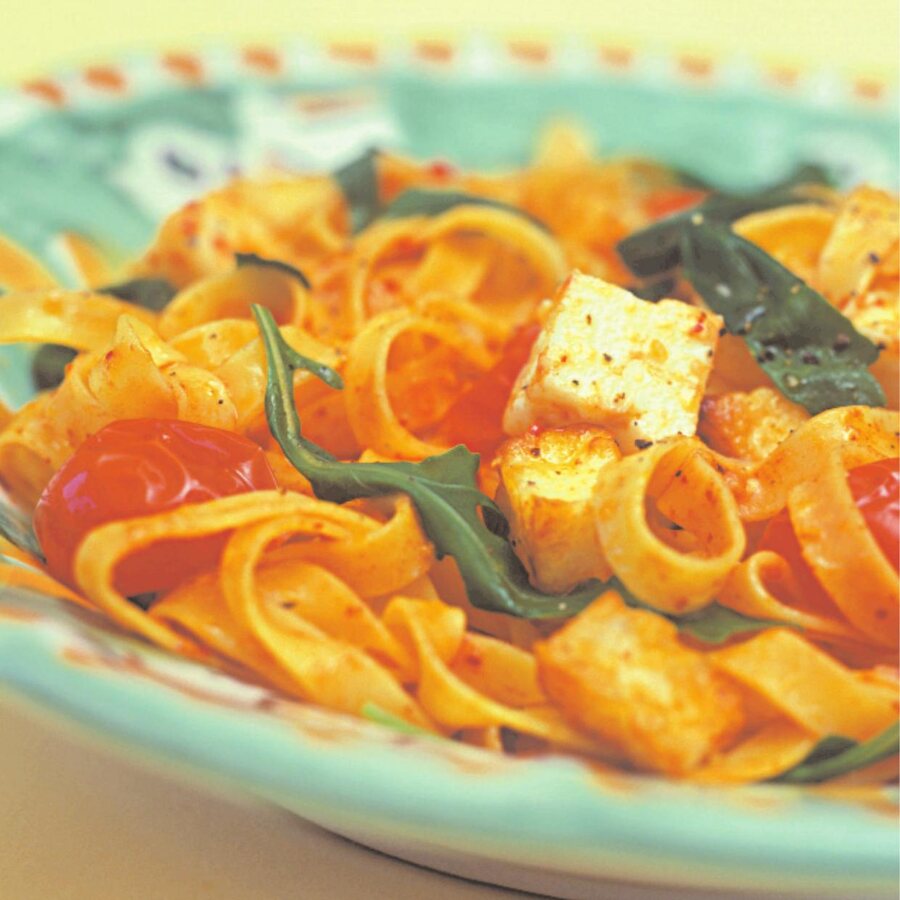
Main Courses
Pasta with Halloumi, Arugula and Cherry Tomatoes
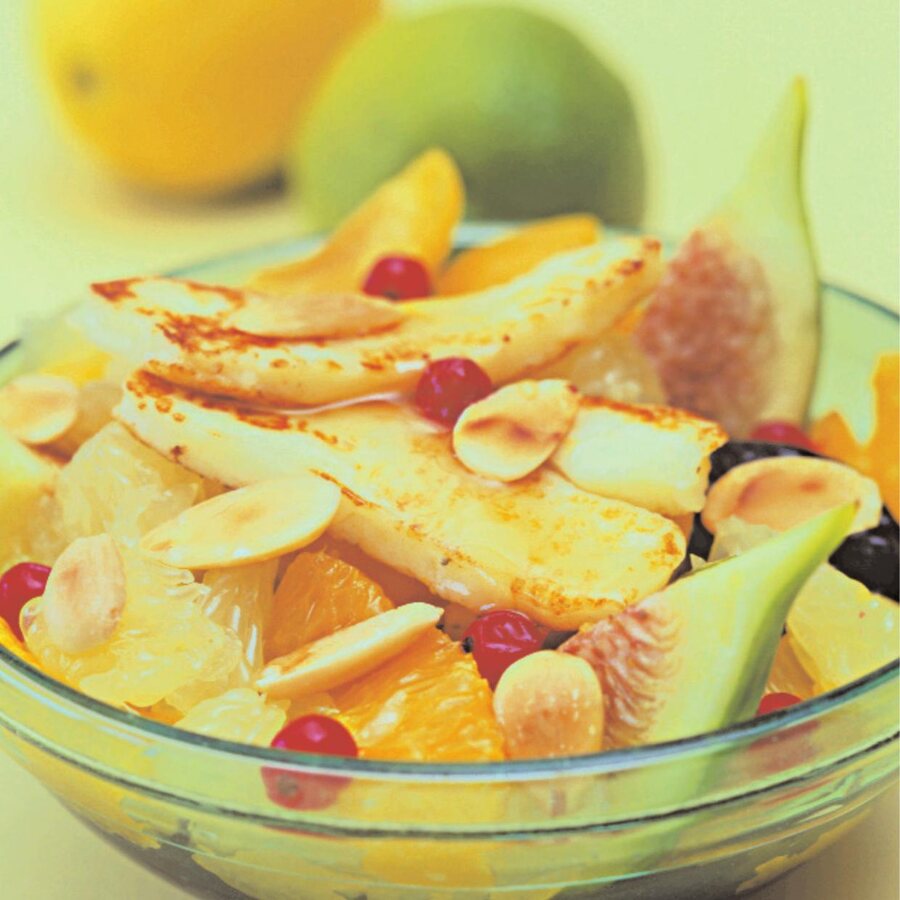
Breakfast & Brunch
Halloumi with Fruit and Honey


Fresh and mature halloumi
Halloumi is not a single fixed thing. The same cheese changes with time in brine, and Cypriots have always used both ends of that range.
Fresh halloumi — eaten within days or weeks of making — is softer, moister and milder. Its salt is present but restrained, the milk character is still clear, and it is at its most elastic. This is the halloumi for grilling and frying, and the one most people outside Cyprus have met.
Halloumi kept longer in brine loses moisture and gains salt. It firms, dries and sharpens, and its flavour concentrates. Mature halloumi is less often eaten in slices and more often grated over pasta, pulses or eggs, where a little of it seasons a whole dish. Traditionally this was simply what happened to the cheese made in spring and eaten in winter, rather than a separate product.
Chilled keeping, freezing and handling after opening are covered under halloumi storage and shelf life. Where dietary questions come up, they are addressed on halloumi nutrition and dietary considerations.
Halloumi for retail and foodservice
Halloumi behaves unusually well as a commercial product, and that is much of why it has travelled. It is sold chilled, it keeps unopened for a useful period, it does not need careful handling on a shelf, and it is bought by customers who already know what they want to do with it.
In retail, the cheese sells on recognition. Halloumi has moved from a speciality item to a fixture of the chilled aisle in a number of markets, and the packs that perform are the ones that make provenance and format obvious at a glance. Retail-sized packs suit that use.
In restaurants and hospitality, halloumi solves a specific problem: a substantial, meat-free component that can be cooked to order in two minutes on equipment the kitchen already runs. It portions predictably from a block, it produces very little waste, and it holds its cost per cover steady. Larger foodservice blocks are made for exactly that — cut to the thickness a kitchen wants rather than the thickness a pack dictates.
Across foodservice more broadly — hotels, catering, contract dining — it is the same argument: consistency of supply and consistency of behaviour under heat. Our retail packs and foodservice blocks, with the formats we supply, are listed on the PittaS halloumi products page. For pricing, specification sheets and shipping, a trade enquiry reaches us directly and is answered within one working day.
Halloumi from PittaS
PittaS is a family dairy in Nicosia, Cyprus, established in 1939. Three generations of the Pittas family have made halloumi from Cypriot milk in the same city, and the business remains family-owned. We make one cheese, and we have never seen a reason to make more.
The dairy supplies trade partners in Cyprus and in international markets, in retail packs and foodservice blocks. Beyond that we prefer to let the documentation speak: specifications, certification and market detail are supplied to partners on request rather than summarised loosely on a web page. If you are assessing us as a supplier, the shortest route is to tell us what you need and what market you are supplying, and we will send the relevant paperwork.
The rest of this section — the answers to the questions we are asked most — is collected under halloumi questions and answers.
Frequently asked questions about halloumi
- What is halloumi?
- Halloumi is a semi-hard brined cheese traditionally associated with Cyprus. It is made by heating the curd, folding it by hand and keeping it in brine, which gives the cheese its firm, layered texture and its ability to be grilled or fried without collapsing.
- Where does halloumi come from?
- Halloumi is a Cypriot cheese. It has been made on the island for centuries and remains part of everyday Cypriot cooking as well as a significant export.
- Is halloumi from Cyprus?
- Traditionally, yes. Cheeses of a similar style are produced elsewhere, but halloumi's origin, its name and its place in the kitchen belong to Cyprus. PittaS has made halloumi in Nicosia since 1939.
- What makes halloumi different from other cheeses?
- Two things: the curd is heated during production rather than simply pressed, and the finished cheese is kept in brine. Together these produce a firm, slightly springy cheese that is salty, mild in flavour and stable under heat.
- Why doesn't halloumi melt?
- Heating the curd during production sets its protein structure before the cheese is formed. Once set, that structure does not flow when reheated, so halloumi softens and browns in the pan instead of spreading.
- How do you cook halloumi?
- Halloumi is usually sliced and cooked over direct heat: grilled, pan-fried, barbecued or baked. It needs no added fat in a hot pan and only a short time on each side, until the surface is golden.
- What is PDO halloumi?
- PDO stands for Protected Designation of Origin, an EU scheme that reserves a product name for goods produced in a defined place and to a registered specification. Halloumi is registered as a PDO name, and producers must meet the terms of that specification to use it.
- Is halloumi suitable for grilling?
- Yes. Halloumi is one of the few cheeses that can be placed directly on a grill or barbecue. It holds its shape, takes on colour quickly and is best served straight from the heat.
- How should halloumi be stored?
- Halloumi is kept chilled and, before opening, in its brine or vacuum pack. Once opened it should be kept covered and refrigerated, and used within a short period.
- What is the difference between fresh and mature halloumi?
- Fresh halloumi is eaten young: softer, milder and more elastic. Halloumi left longer in brine becomes firmer, drier and saltier, and is often grated or used in cooking rather than eaten as slices.